
Traditional Chinese Medicine
Counteract Summer Heat With Chinese Herbal Teas
In spite of thus far boasting minimal over-heated days that inspire associations of barbecues and the beach, Summer is upon us
At home we joined our community pool, which is supposedly very popular and only a short walk from our home, but are yet to throw the baby in, as the only days that temperature might have permitted have been of coinciding rainstorms. The humidity just recently arrived, which for me is a bit of an ironic breath of fresh air, as a New York (New Jersey) summer sans the dense filth of 90-degree oppression on train platforms would resonate as just another bittersweet symptom of global warming.
Chinese Medicine appropriately labels this as “damp heat,” a very serious pathogen that genetically applies to yours truly and is nothing to be snoozed at. When dampness, or pathogenic body fluids mix with inflammatory heat they form an often impenetrable pathogen the Chinese label as “phlegm,” and “the cause of 1000 diseases.”
“Phlegm” in our medicine refers to not only that of the lungs and sinuses, but also the plaques that create arteriosclerosis, polyps, Alzheimer’s Disease, fatty liver, and I suppose about 1000 more illnesses. If someone is genetically susceptible to heat, left untreated their own dampness will inevitably transform into “damp heat” and become that much more difficult to resolve. Think many cases of autoimmune disease, cancers, and diagnoses of similar gravities.
Typically, the American trademarks of summer are in direct opposition to Eastern Medicine’s advice for mitigating the side effects of the external damp heat. Red meat and barbecue are sources of damp heat, as is alcohol—especially beer—spicy foods, or shellfish. As one of a family of many gout sufferers I must pick my spot wisely to indulge in one of my favorite summertime meals, oysters and some snobby, local IPA. At the least I always attempt to resolve such indulgences’ side effects on their backends.
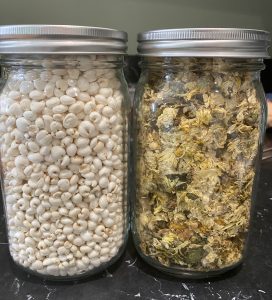
More cooling foods and drinks that should be ingested liberally include watermelon, cucumber, celery (or celery juice), lemon, radishes, and of course chamomile or mint teas. Other recommended food grade medicinal teas are ju hua (chrsyanthemum flower) and yi yi ren (job’s tears/pearl barley), both of which should be available at any Asian market.
While the former is great for clearing heat in the upper portion of the body—think possibly headaches, summer dizziness, styes, and any issues of redness around the eyes—the latter is directed more to the intestines and urogenital microbiome. This time of year people are more prone to hyperhidrosis below the belt, swelling of the limbs, UTI’s, hemorrhoids, or stickier stools. If you wish to live in accord with the season and do better than low-quality store-bought herbal teas, I recommend getting these ingredients for tea at home.
30 grams of job’s tears + 10 grams chrysanthemum + 8 cups of water.
Boil and simmer for 40 minutes, drain out the herbs, and drink the slightly bitter, earthy tea. If you cannot measure grams and/or want to make a full pitcher for the week it’s fine to eyeball the measurements, simply aiming for a 3:1 ratio of job’s tears to chrysanthemum. In Chinese Medicine the bitter flavor is indispensable at clearing heat from the body, and recommended that westerners acclimate our palettes to it.
Finally, each season brings its own recommendations around our circadian rhythms. Summer corresponds with the fire element, which corresponds with the heart organ. The hours assigned to the heart are 11am-1pm, which for the next few months makes this an optimum time for 15-30 minutes of rest and relaxation. I realize most people, myself included, are usually quite busy at this time, but whenever possible it is ideal for heart health to take a pause, to close our eyes, lie down for a short meditation, and/or book your acupuncture visits accordingly (this from one of my most respected teachers, Dr. Henry McCann).
Please don’t get me wrong. The experience summer barbeques with friends is, in my opinion, one of life’s finest treasures, and should never fall by the wayside. However, it is advisable to eat mindfully the remaining 90% of our time, and appropriately to always counterbalance our indulgences on the day after.
Acupuncture for Treating Addiction
People seeking treatment for addiction typically have a complex road to recovery. Everyone’s story is different, and people have different needs and respond to treatment in their own time and in their own way. What many people might not be familiar with are the supplemental therapies that can be used to help promote healing and recovery. One of those supplemental therapies is the National Acupuncture Detoxification Association (NADA) acupuncture protocol. continue reading
4 Ways Acupuncture Can Be Used
To ask what can acupuncture treat is a bit like asking what can be improved by green vegetables or water, exercise, sleep, or meditation. Acupuncture is inherently anti-inflammatory, inherently pro-circulatory, plus systemically modulatory, so in theory as well as in its highest level of practice, it can improve nearly any condition. Whether or not a full resolution is available depends on the severity of the condition, skill level of the practitioner, and the lifestyle of the patient.
People use acupuncture for all different reasons, the first and most obvious being treatment towards HEALING. They come weekly for between 2-6 months, take heed to corresponding Eastern diet and lifestyle recommendations until their chief complaint is more or less fully resolved. This is ideal.
Others use acupuncture for SUPPORT, while going through something like chemotherapy treatments, intense physical training, and/or just a difficult time in life. The body somatically discerns only so much difference between these three. Weekly or bi-weekly treatments within such contexts can go lengths to mitigate their side effects, minimize suffering, and long-term ails as a result. The scientific research on acupuncture’s benefits while going through chemo is abundant and well-known at this point. We most often try to support the body’s healthy fluids and cellular energy that the oncology treatments have to exploit, additionally limiting side effects such as neuropathy, diarrhea, or just general fatigue.
RECOVERY is another great option when we miss the window on support. Immediate post-surgical recovery is a realm in which acupuncture thrives and has gotten great recognition in the west in recent years, where I’ve even heard of it being prescribed by surgeons the way physical therapy has always been. Frequent acupuncture can prevent the formation of scar tissue post-surgery, which many years down the line can prevent arthritis. We can never know how many problems we’ve avoided through pro-activity (personally, when I reach the other realm I do hope to get a full report).
That leads me to PREVENTION. Not everyone has symptoms, but everyone has a pattern. We all have genetic weaknesses, organ systems, or body parts where we are more vulnerable and inflammatory. Our patterns, or respective physiological constitutions are generally leading us towards our own unique discomforts or diseases. What holistic medicines have to offer is regular treatments intended at balancing these patterns and subsequently delaying and/or minimizing potential suffering. While this is most commonly used by young athletes to prevent physical injuries, I personally find the greatest reward in using electo-acupuncture at particular scalp regions on elderly patients to prevent cognitive decline and neurological disease.
This is one of the cool things about practicing Chinese Medicine—that on any given day I get to see a group of people, each of whom are coming to me at different stages in their lives and healing journies, thereby requesting a very different thought process and approach. It keeps me on my toes, which hopefully might act as a source of prevention of my own cognitive decline.
So thank you!
What to Expect at Your First Acupuncture Appointment
Just like every patient is unique with specific needs and expectations, every practitioner is also unique with specific needs and expectations. If acupuncture is a new experience for you, you might be wondering what to expect. While not every practice is the same, there are a few general principles that will guide your first appointment. continue reading
The Physiology of Wildfire Smoke (in NYC)
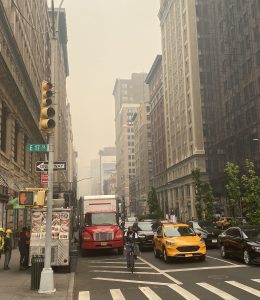 While the sepia tones and brush aromas from this week’s Canadian wildfires’ spillover to the northeast might have looked great in a photograph, or smelled enticing in 1% of its dosage (if seated by a campfire with marshmallows), on the ground in real life it was daunting, and for many systemically disruptive. Personally, I was outdoors plenty, both on my commute and on my break at Union Square farmer’s market, albeit with a mask on, and thankfully did not experience symptoms.
Chinese Medicine nicknamed the lungs “the delicate organ,” which really they are not—in fact quite the opposite—however what is meant by this is their being most and primarily vulnerable to external pathogens. Toxic fumes are an external pathogen. They dry the sinuses and respiratory microbiome, which can bring with it symptoms such as chest oppression, frontal (or maybe temporal) headaches, and of course, dryness. Or as my wife and I learned, if you are a 2-year-old trapped indoors as a result, rabid, recurring cases of cabin fever.
The formula everyone needed at least one day of at home this week was “Xiao Chai Hu Tang,” or “Minor Buplureum (root) Decoction.” It includes buplureum root to clear heat from the upper body by increasing circulation downwards; pinellia root to dissolve accumulation in the chest and sinuses; scutellaria root to clear heat specifically from the lungs; ginseng to generate healthy fluids in the stomach to protect it from the bitter nature of the other herbs; ginger to warm the stomach for a similar reason; and finally licorice and red dates to generate healthy fluids in the stomach, chest, and central nervous system.
It’s no wonder this is one of the most commonly prescribed herbal formulas in Chinese Medicine. Nevertheless, it should almost always be modified according to the individual; especially those with low energy, low appetites, and/or aversions to cold weather. Typically, these were the body types I saw most impacted by the air pollution this week. Frontal headaches, dryness in the throat, and chest oppression, as a result of the external toxicity exacerbating their pre-existing internal toxicities as a result of metabolic dysharmony. Not to worry, as my father always said. There’s hope.
If any symptoms are lingering and you are not presently coming for acupuncture or taking herbs I would recommend any or all of the following:
- Hot mint tea, maybe with honey, to open the chest, cool, and lubricate the sinuses
- Asian pears, or fresh pear juice, also to lubricate the lungs and sinuses.
- Rice congee with chopped up pears, red dates, some honey and cinnamon—YUM—to generate healthy fluids in the respiratory and gastrointestinal microbiomes.
- Gentle exercise, such as qi gong, yoga, or deep breathing. NOT… outdoor running, for the love of God.
- If nothing else, just stay hydrated, preferably with room temperature or hot water. Cold drinks constrict blood vessels, which obviously then traps local inflammation.
These are great treatments to treat only the branch of the problem, as its root cause is of course Republicans.
